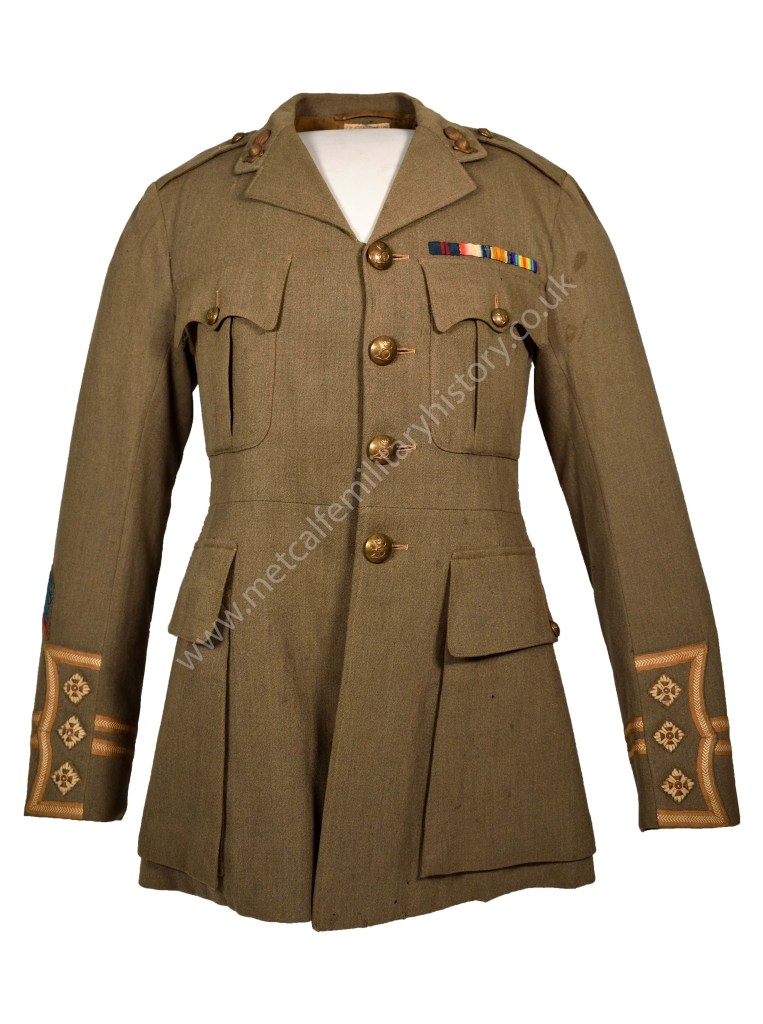
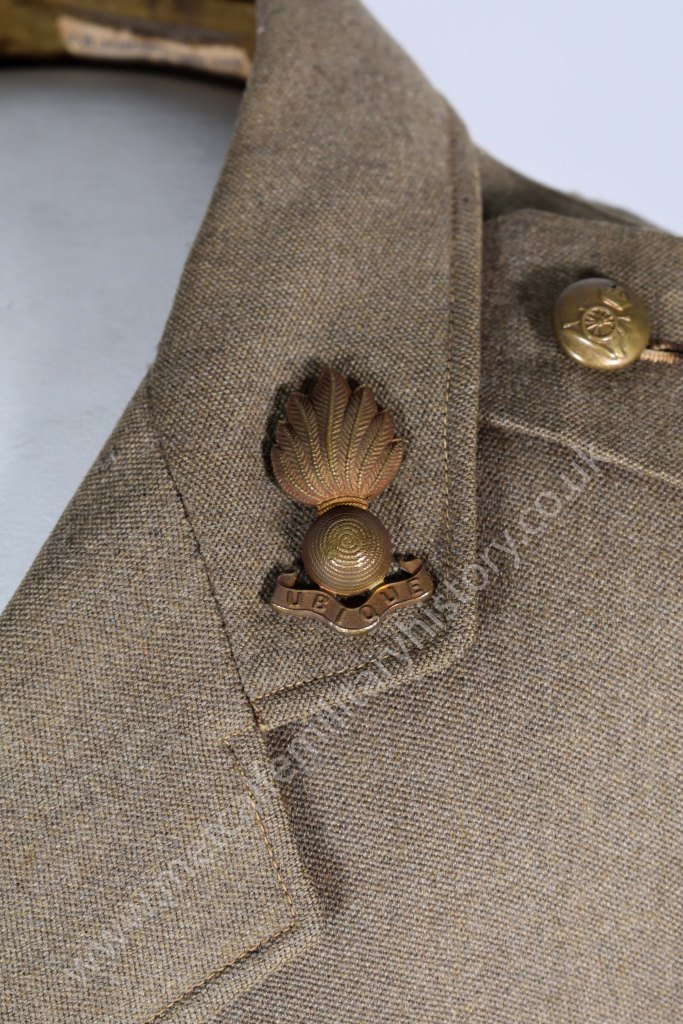
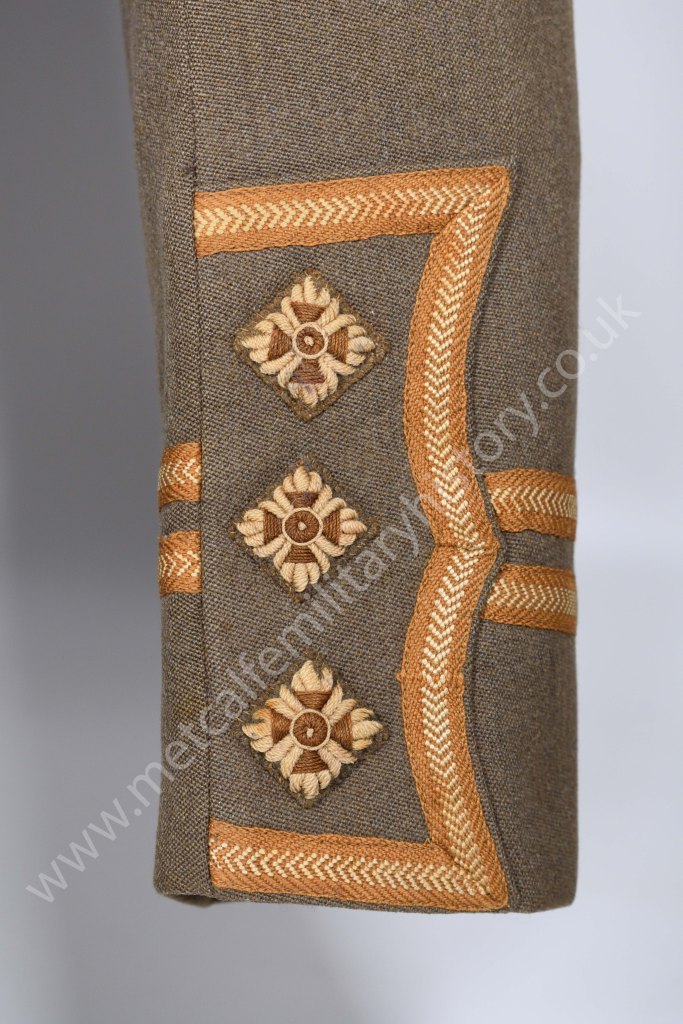
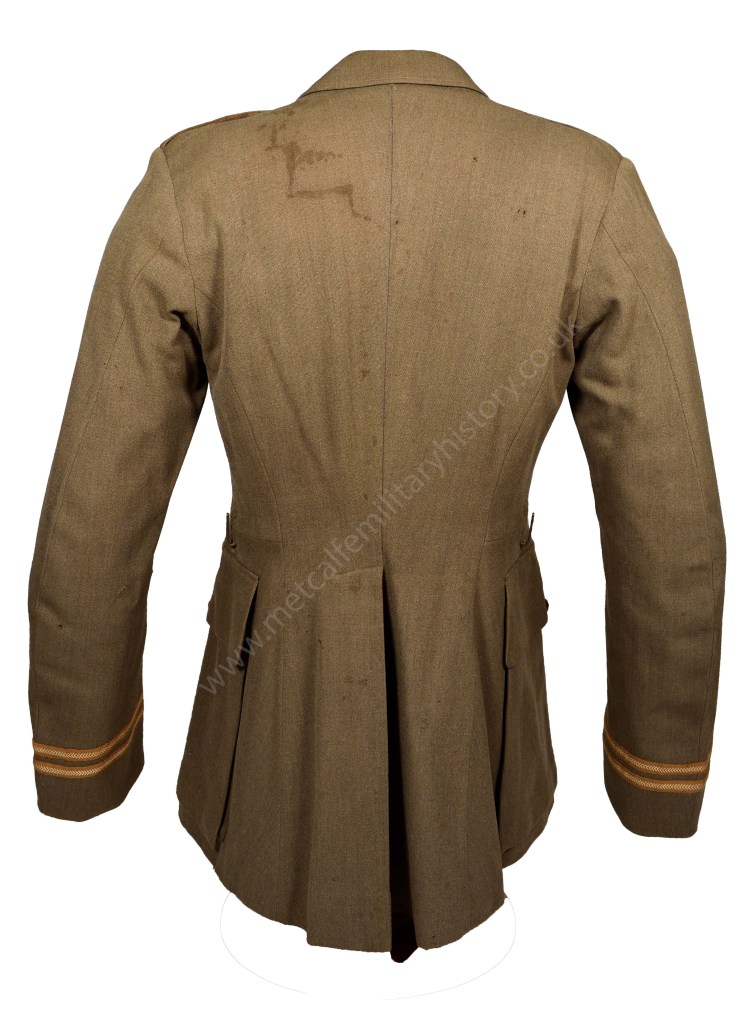
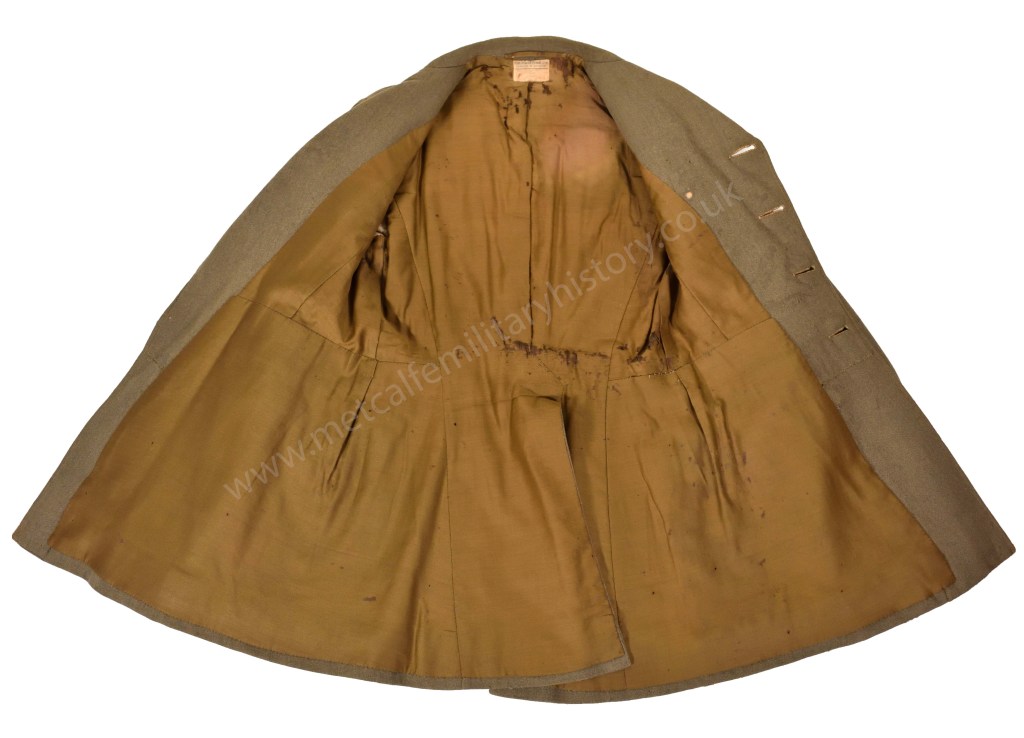
The British officer of the Great War was easily identified by the distinctive jacket with badges of rank worn on the cuff. This wasn’t an exact rule for all regiments, but the majority wore these jackets going into war in 1914. As war progressed, officers started to wear badges of rank on the shoulder strap, rather than the cuff, as this distinction had made them easily identified targets for the enemy. This particular Great War period officers jacket belonged to Harold Vernon Lee, an officer with the Royal Field Artillery. It is likely he wore this jacket while serving in Italy in 1918.
Harold Vernon Lee
Harold Vernon Lee was born at Ludlow, Shropshire on 5th June 1896 to Charles and Adeline Lee. By 1911, the family had moved to London, most likely due to Charles’ work as a Civil Servant. Harold was subsequently educated at Commercial College, Ludlow and then St Peter’s School, Eaton Square, London.

In 1913, Harold emigrated to Canada and began work as a farmer. On the outbreak of war in August 1914, Harold was amongst the first to enlisted in the Canadian forces, joining the 31st Regiment, British Columbia Horse on 12th August. He only served for three weeks and then transferred to the Royal Canadian Horse Artillery (RCHA) at Valcartier on 7th September 1914, joining ‘A’ Battery. Strangely, he gave his year of birth as 1897 on enlistment, not the correct 1896. He did however give the correct year of 1896 when applying for his commission in 1916!
6221 Gunner H V Lee
After a very brief period of training in Canada, Harold sailed for England with his unit on 3rd October 1914. His training then continued in England, along with the rest of the Canadian Expeditionary Force (CEF), ready for action on the Western Front. It was whilst in Maresfield, East Sussex that Harold forfeited two days pay for being absent.
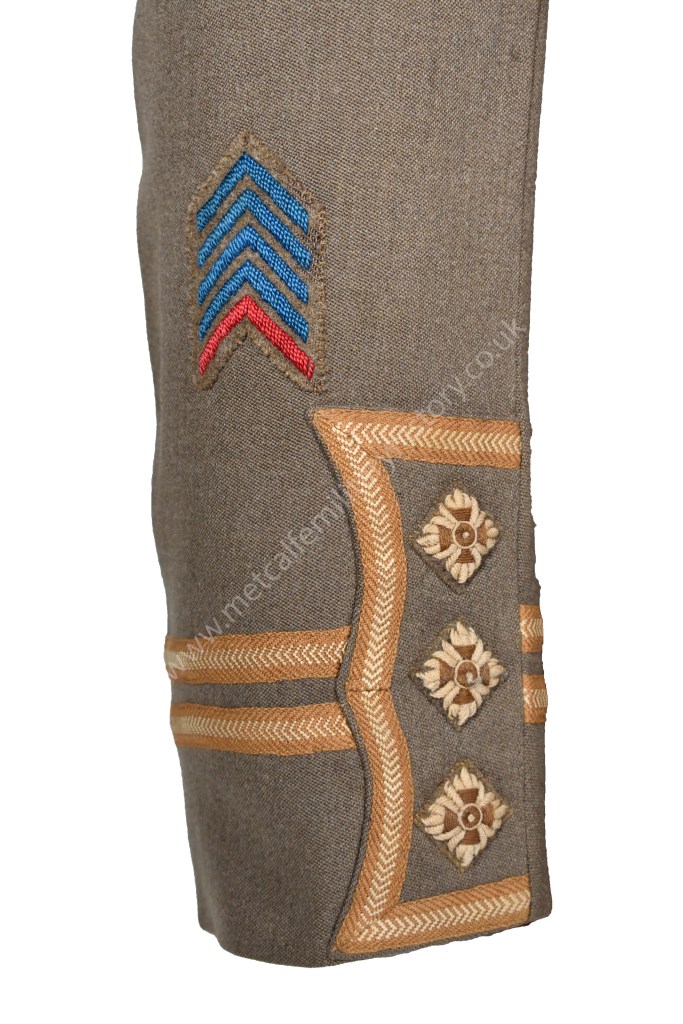
On 20th July 1915 after a two day crossing, Harold landed at Le Harve, France with the RCHA as part of the Canadian Cavalry Brigade.
On 11th December 1915, Harold was promoted to Acting Bombardier and it’s likely that he had shown natural leadership skills. This was confirmed in May 1916, when he returned to England to train for a commission and become an officer. Harold successfully completed his commissioning course at St John’s Wood, London, but instead of becoming an officer in the Canadian Expeditionary Force (CEF), he joined the British Army and was discharged from the CEF.
On his application for a commission, his reference for moral character was given by John Storrs, Dean of Rochester. John Storrs was born in Canada and had been the Vicar at St Peter’s, Eaton Square (where Harold had attended school). Perhaps he had a factor in Harold’s decision to emigrate to Canada?
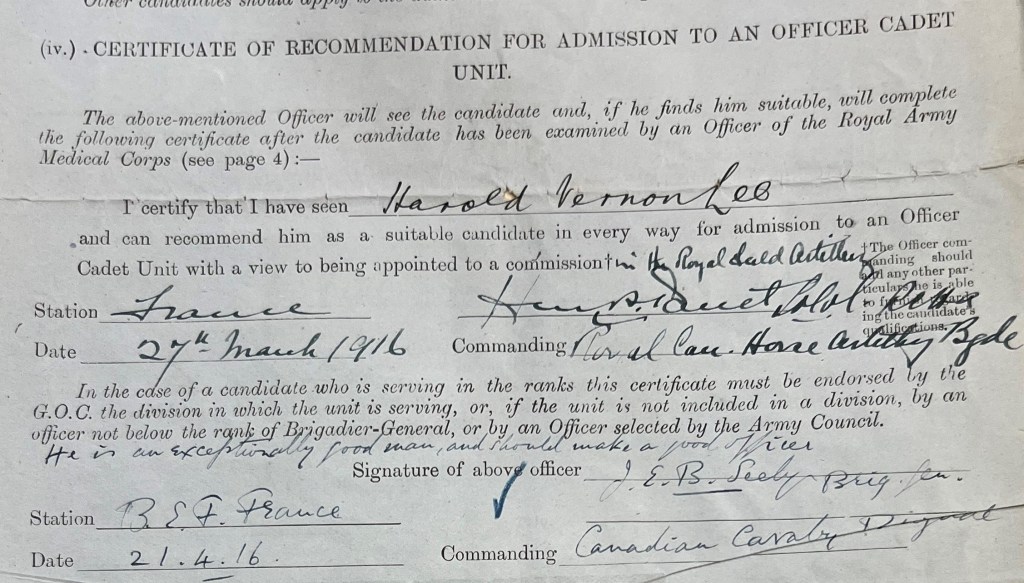
Harold also received a recommendation for commission from the commander of the Canadian Cavalry Brigade. Whilst this was standard practice for a soldier commissioning from the ranks, what’s unusual is the hand written note by the commander, Brigadier General J E B Seely. He wrote of Harold “He is an exceptionally good man, and should make a good officer”. Jack Seely had been the UK Secretary of State for War from 1912 – 1914.
Lieutenant H V Lee
Harold’s commission was gazetted on 25th October 1916 into the Royal Field Artillery.
In March 1917, Harold was admitted to No.2 General Hospital with Mumps for 21 days before returning to duty. At this time, he was listed as serving with V/7 Trench Mortar Battery, the heavy trench mortar battery for 7 Corps.
In January 1917, he was temporally promoted to Acting Captain for three weeks, presumably to will a specific role, possibly command of a Trench Mortar Battery. In January 1918 he was again promoted to Acting Captain, this time for a longer period, until November 1918.
Harold suffered further medical complications in 1918, by which point he was serving with a Trench Mortar unit of the 7th Division in Italy. He was admitted to No. 24 Casualty Clearing Station on 16th August 1918 with Dysentery and then to the Officers Convalescent Hospital in Portofino. By 25th November 1918 his health had deteriorated again and he was admitted to No.23 Field Ambulance with Jaundice. This was serious and he was transferred to No.24 Casualty Clearing Station and then onto No.62 General Hospital. Although he was making slight improvement by late December, he was evacuated to France, arriving at No.81 General Hospital. Within days of arriving back in France, he was sent back to the UK for treatment at No.3 London General Hospital. On 18th January 1919 he was examined by a Medical Board and downgraded to C1 – fit for Home Service only.
Harold was demobilised on 15th April 1919 and formally relinquished his commission on 1st April 1920 as a Lieutenant and granted the rank of Captain. On leaving the army, he gave his initial address at Kamloops, Canada.
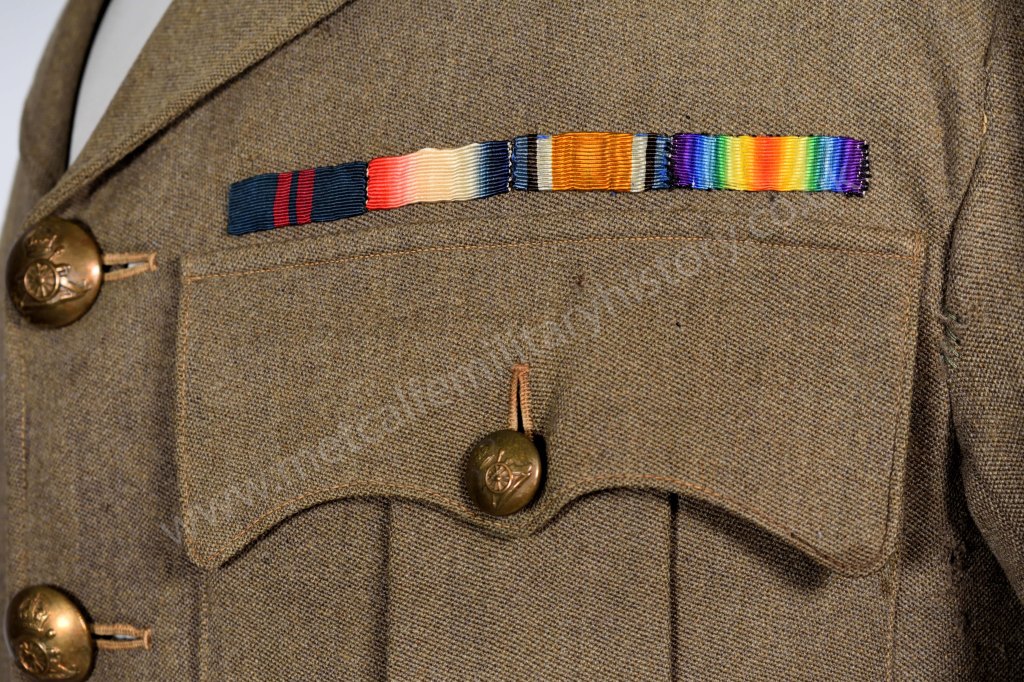
For his service in the Great War, Harold was awarded the 1914-15 Star, British War Medal and Victory Medal. His jacket also has the ribbon for the Delhi Durbar Medal of 1911, although absolutely no record of this entitlement could be found.
To the United States of America
On 18th April 1920, Harold arrives in Blaine, Washington, USA via the Great Northern Railway from Mission Junction, Canada and by the end of the year, was living at Fallbrook, California. Only a few months later, he married Eunice Skeel, noted by a local society magazine as a “prominent Cleveland girl” and daughter of Dr Edward Skeel of Los Angeles (LA). The wedding took place at West Adams Methodist Episcopal Church LA and the ceremony performed by Bishop H Welch of Korea, an old friend of the bride’s family.
They went on to have two children, Mary and Roland Edward who were both born in San Diego. Roland would go on to serve with the US Air Force as a fighter pilot in WW2 and Korea. He was sadly killed in action on his 71st mission in Korea on 27th September 1950.
His pre-war life in Canada as a farmer now must have seemed a world away to Harold. In July 1921 he started his own business – The H. V. Lee Company, an automobile paint shop at 1041 Columbia Street, San Diego. In 1926, Harold became a naturalised US citizen and at this point the family were living at 394 San Antonio Street, San Diego. In 1929 Harold must have suffered from some medical complications as his Doctor, C. Pennell Baxter M.D. wrote to the War Office back in the UK requesting his wartime medical records to assist with treatment.
The Harold V. Lee House
In 1928, Harold was enjoying his success and had a Tudor Revival style house designed by architect Frederick C. Clemeshaw and built by George Simpson. The house survives to this day, although it has been moved from it’s original location in 2002 to the Civic Center Park. It is now the home of the Lemon Grove Historical Society.
When the Second World War broke out, Harold gave speeches on the war, drawing on his own experiences from 1914 – 1918. He strongly felt that Germany must be completely defeated to avoid the repetition of history again after the treaty of Versailles.
Harold died aged 90 at La Jolla, San Diego on 20th September 1986.
 Metcalfe Military History